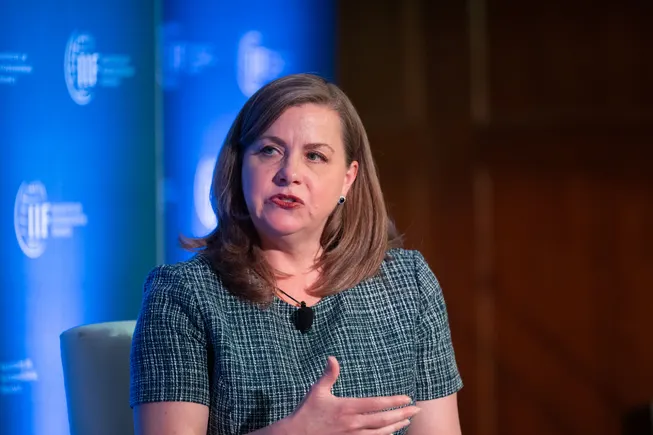
Regulators Testify Before House Financial Services Committee
Four leading regulators testified in front of the
Financial Services Committee
on Tuesday – marking the first en-masse check-in with Trump-era finance figureheads this year since many
of them took their posts.
Perhaps predictably, the most frequent subject, arguably, was “tailoring” – a
tone set early in the hearing by Rep. French Hill, R-AR, the committee chair, who cited “broad bipartisan
recognition” in Congress that banking rules should be adjusted to fit an institution’s size, complexity
and risk profile.
Michelle Bowman’s Perspective
Michelle Bowman, the Federal Reserve’s vice chair for supervision, said she supports
increasing “static and outdated” thresholds that, in her view, have forced smaller banks to adhere to rules
written for larger lenders. That includes thresholds tied to asset growth, which Bowman said has accelerated
in part because of inflation. It also applies to anti-money laundering-related thresholds, beyond which banks
must file currency transaction reports and suspicious activity reports, Bowman said.
Rep. Andy Barr, R-KY, chair of the House Financial Institutions Subcommittee, asked
Bowman if banks with less than $10 billion in assets may be dissuaded from growing because of the stricter
rules they’d have to follow for stretching past that threshold.
“In my experience of working with community banks that are approaching the $10 billion
threshold, it certainly does disincentivize their growth,” Bowman said. “It gives them few options to be able
to address the additional supervisory requirements that are imposed at that threshold level.”
Bowman noted that the Fed is working to tailor the mergers-and-acquisitions process
for community banks, along with the de novo application process.
“We are exploring streamlining these processes and updating the Federal Reserve Board’s
merger analysis to accurately consider competition among small banks,” Bowman said. “Now is the time to build
a framework for community banks that recognizes their unique strengths and supports their critical role in
providing financial services to businesses and families throughout the United States.”
Other Regulators’ Plans
Other regulators, too, outlined rules they intend to float in upcoming weeks and months.
Federal Deposit Insurance Corp. Acting Chair Travis Hill said he expects to issue a proposed rule to establish
the agency’s application framework related to stablecoins later this month.
National Credit Union Administration Chair Kyle Hauptman appeared more determined
to weed out rules that don’t apply than to create new ones.
“We are reviewing the entirety of our regulations to focus on measurable and material
risks, not on enforcing outdated and obsolete requirements,” Hauptman said Tuesday. “Removing outdated, overly
prescriptive, and unduly burdensome requirements will allow credit unions to serve their memberships while
NCUA focuses on risks to safety and soundness.”
Jonathan Gould, who leads the Office of the Comptroller of the Currency, indicated
his agency would dive deeper to investigate complaints of alleged debanking.
“We will be considering options for evaluating whether and to what extent non-financial
factors may have influenced or impacted core banking functions such as credit underwriting practices,” Gould
said.
Bowman, meanwhile, looked ahead to a new effort to reconcile with Basel III standards.
She assured lawmakers that regulators “don’t have a preconceived notion about where we’ll land with our capital
requirements.”
“We’re looking at it from a risk-based approach by each factor and category,” she
said. “My approach is to address the calibration of the new framework from the bottom up, rather than reverse-engineer
changes to achieve pre-determined or preconceived approaches to capital requirements.”
Barr, for his part, cautioned that an “America-first banking regulatory agenda
should not seek to achieve international regulatory harmonization for harmonization’s sake.”
“Instead, it should seek to advantage American economic competitiveness,” Barr
said, noting that “of course” banks should be well-capitalized and their activities safe and sound.
“But … we should be focused on economic growth as we balance economic and financial
stability,” he added