The Crucial Choice: Public vs Private Blockchains for Banking
As the financial industry has grown beyond the debate of whether blockchain is relevant, the new question has become how best to implement it. Major players in the banking sector, including the New York Stock Exchange, are making strides towards adopting blockchain technology. The real question, however, lies in whether these institutions should build on proprietary systems, controlled by vendors and consortiums, or opt for open networks with no single owner. A wrong decision could lead to long-lasting lock-ins, limiting flexibility and creating dependencies.
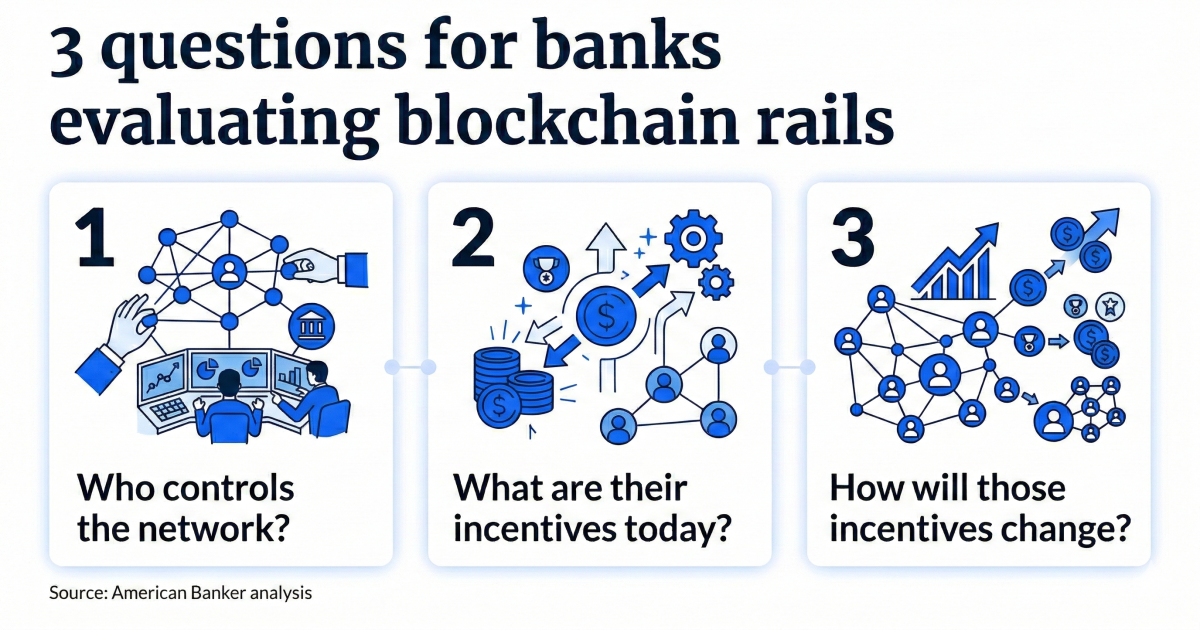
Visualization created with AI assistance based on original reporting.
The Pros and Cons of Ownership
When infrastructure is owned, owners primarily serve shareholders. This often leads to monetization pressure and pricing power over captive customers. As market power accumulates, the incentives of the owners diverge from those of the users. Yet, open infrastructure operates differently. With no shareholders to satisfy, fees can remain minimal, access remains open, and standards can evolve for users rather than owners. Four primary advantages emerge from this approach.
Interoperability Without Permission
Private blockchains require bilateral agreements to connect with other networks. A bank utilizing one consortium’s infrastructure can’t transact with a bank on another’s without middleware, negotiations, or both. Public networks, on the other hand, allow any-to-any connectivity by default. According to the World Bank, average cross-border payment costs are 6.49% of transaction value. Interoperability directly combats these costs.
Reduced Concentration Risk
The Dallas Fed recently highlighted the systemic vulnerability technology service providers pose for financial institutions. This risk applies to blockchain infrastructure as well. Single-operator networks, even those run by sophisticated entities, introduce single points of failure. In contrast, distributed networks spread that risk across independent validators in multiple jurisdictions.
Better Auditability
Open networks provide better auditability, allowing regulators and auditors to observe transactions directly. The Bank for International Settlements noted this in its 2025 annual report, stating that the transparency of tokenized platforms enables regulatory oversight rather than undermining it.
Quick Adaptation to Changes
Public infrastructure is generally faster to adapt to changes. Proprietary systems evolve at the pace set by their owners, which is often slow. Open networks, conversely, allow independent teams to develop, test, and deploy improvements without needing permission from a central authority. This results in an infrastructure that adapts at the speed of business rather than the speed of procurement cycles.
Concerns About Public Infrastructure and Their Answers
Despite these benefits, many banks harbor concerns about public infrastructure. However, there are direct answers to these concerns. For example, control over assets is not necessarily compromised on open network infrastructure. Issuers maintain full compliance controls whether the settlement layer is proprietary or open. As for compliance, major institutions like BlackRock, Franklin Templeton, and Fidelity have successfully tokenized funds on public networks while meeting regulatory requirements. Deutsche Bank Research estimates the tokenized real-world asset market at roughly $33 billion, demonstrating that the compliance model works at an institutional scale.
As for risk, private chains present their own set of risks that are often overlooked. These include gatekeeping by competitors who also run the infrastructure, unilateral rule changes by consortium governance, and single points of failure in operations and decision-making. Banks must carefully consider which risks they prefer to manage.
Key Questions for Evaluating Blockchain Rails
Banks evaluating blockchain rails should ask three key questions: Who controls the network? What are their incentives today? How will those incentives change as the network gains adoption? The answers to these questions will vary greatly between proprietary and public infrastructure. Unlike software vendors that can be replaced with enough effort, blockchain rails create path dependencies. Assets issued on one network, integrations built on one protocol, and processes designed for one architecture can create compounding switching costs over time.
This issue goes beyond ideology. It’s about structural economics: who captures value, who sets rules, and whose interests the system serves. Banks have been on the wrong end of that equation before, but they don’t have to be again. They just need to make the right choice between public and private blockchains.
Source: Here